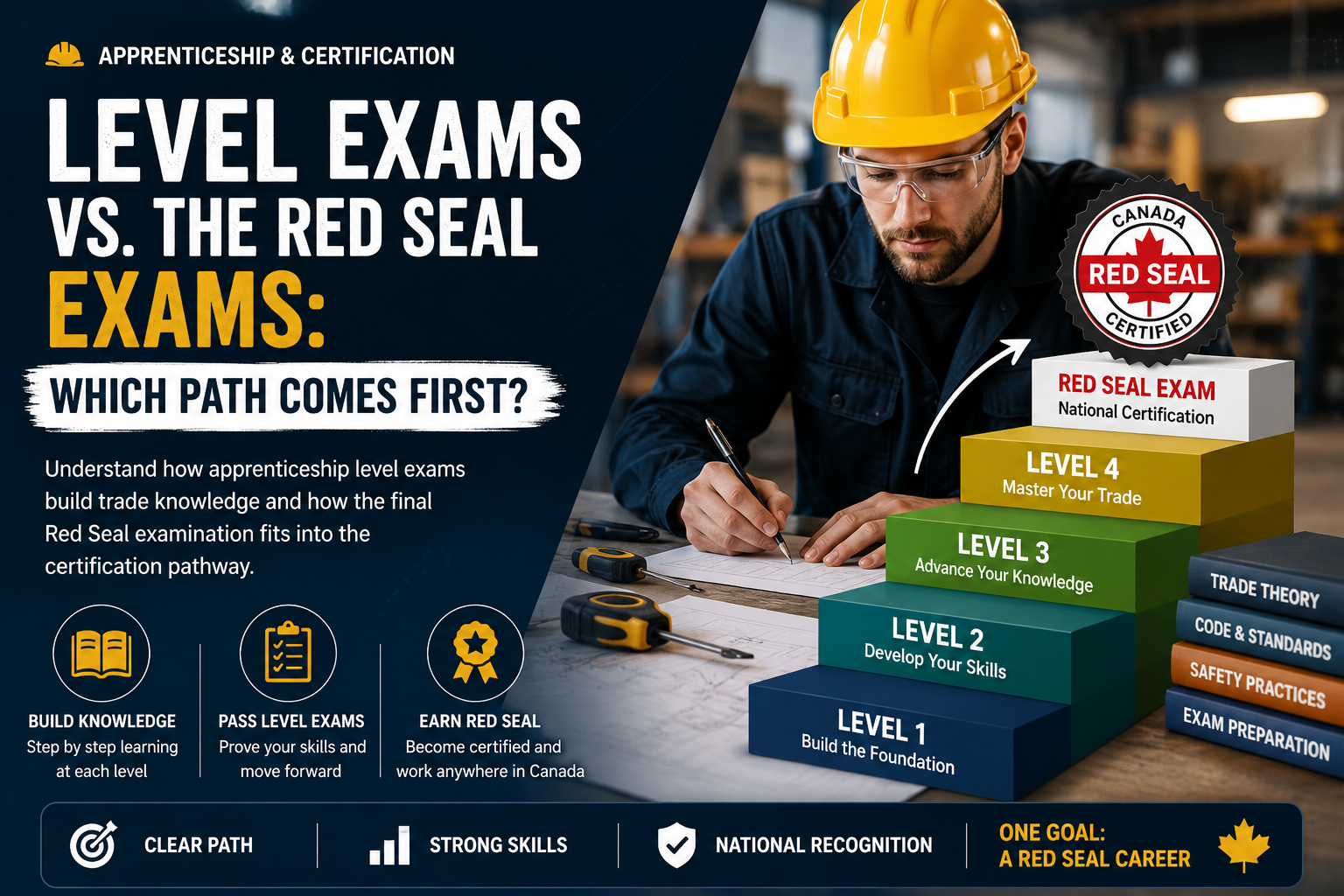
Level exams and the final Red Seal examination serve different purposes. Level exams normally measure the knowledge taught at a particular stage of apprenticeship training. The Red Seal examination is a final, trade-wide certification examination for eligible candidates in participating trades.
The usual apprenticeship pathway
A new apprentice normally begins by working in the trade under supervision, registering with the provincial or territorial apprenticeship authority, recording work-based training hours, and completing the technical training required for the first level.
- Begin working and register as an apprentice.
- Build the required workplace experience for Level 1.
- Attend technical training, or use an approved level-exam challenge route when eligible.
- Pass the Level 1 requirements.
- Continue gaining experience before progressing through the next available level.
- Complete the full apprenticeship and certification requirements.
- Write the final certification or Red Seal examination when eligible.
What a level exam covers
A level exam focuses on one stage of learning. Level 1 generally emphasizes foundations such as safety, tools, materials, terminology, measurements, and basic procedures. Later levels normally introduce more complex installation, service, diagnostics, planning, code application, and troubleshooting. The number of levels differs by trade and jurisdiction.
Can a worker challenge a level exam?
Some jurisdictions provide a level-exam challenge option for registered apprentices who have accumulated the required work-based training hours. For example, SkilledTradesBC publishes minimum hour requirements and eligibility steps for approved level-exam challenges. Studying independently does not by itself create eligibility; the apprenticeship authority must approve the candidate.
What the Red Seal exam covers
The Red Seal exam covers the full occupational scope of the trade rather than one training level. It is usually written after completing an apprenticeship, or after an experienced worker is approved through a trade-qualifier or certification-challenge pathway. A worker with substantial documented experience may be able to challenge the final certification exam without repeating every classroom level, subject to the rules of the province or territory.
Which route normally comes first?
For a new worker, the usual route is apprenticeship: register, gain supervised work experience, complete the required technical training and progress through the available levels. After completing the apprenticeship and meeting the certification requirements, the worker can write the final certification or Red Seal examination.
An experienced worker may follow a different route. Provinces and territories may approve a trade qualifier or challenge candidate who can document experience equivalent to the apprenticeship. Approval is not automatic, and the required hours, forms and evidence differ by jurisdiction.
Can you study independently?
Independent study can help a candidate prepare, but it does not replace eligibility. A person cannot create exam eligibility simply by buying a course or practice test. The responsible apprenticeship authority decides whether the candidate may write a level or certification examination.
How Red Seal Practice can help
Use level-focused practice when preparing for a specific apprenticeship stage. Use full-trade and mock-test practice when preparing for a final certification or Red Seal examination. Practice questions support study, but they do not replace official training, workplace experience, or eligibility approval.